
Beyond 20/20: What a Comprehensive Eye Exam Actually Checks For
Most people book an eye exam when something's clearly off — they're squinting more than they used to, their prescription feels wrong, or a reminder has been sitting unopened in their inbox long enough to become a mild source of guilt.
What most people don't expect is how much is actually being assessed in that room. Reading the letters on the chart is the starting point. What happens around it is where the real value of a comprehensive exam lives.
Dr. Mateo Vacacela, optometrist at Holly Eyewear in Yorkville, sees this regularly. Patients come in expecting a prescription update and leave having learned something they didn't know about their own health.
It Goes Further Than Your Vision
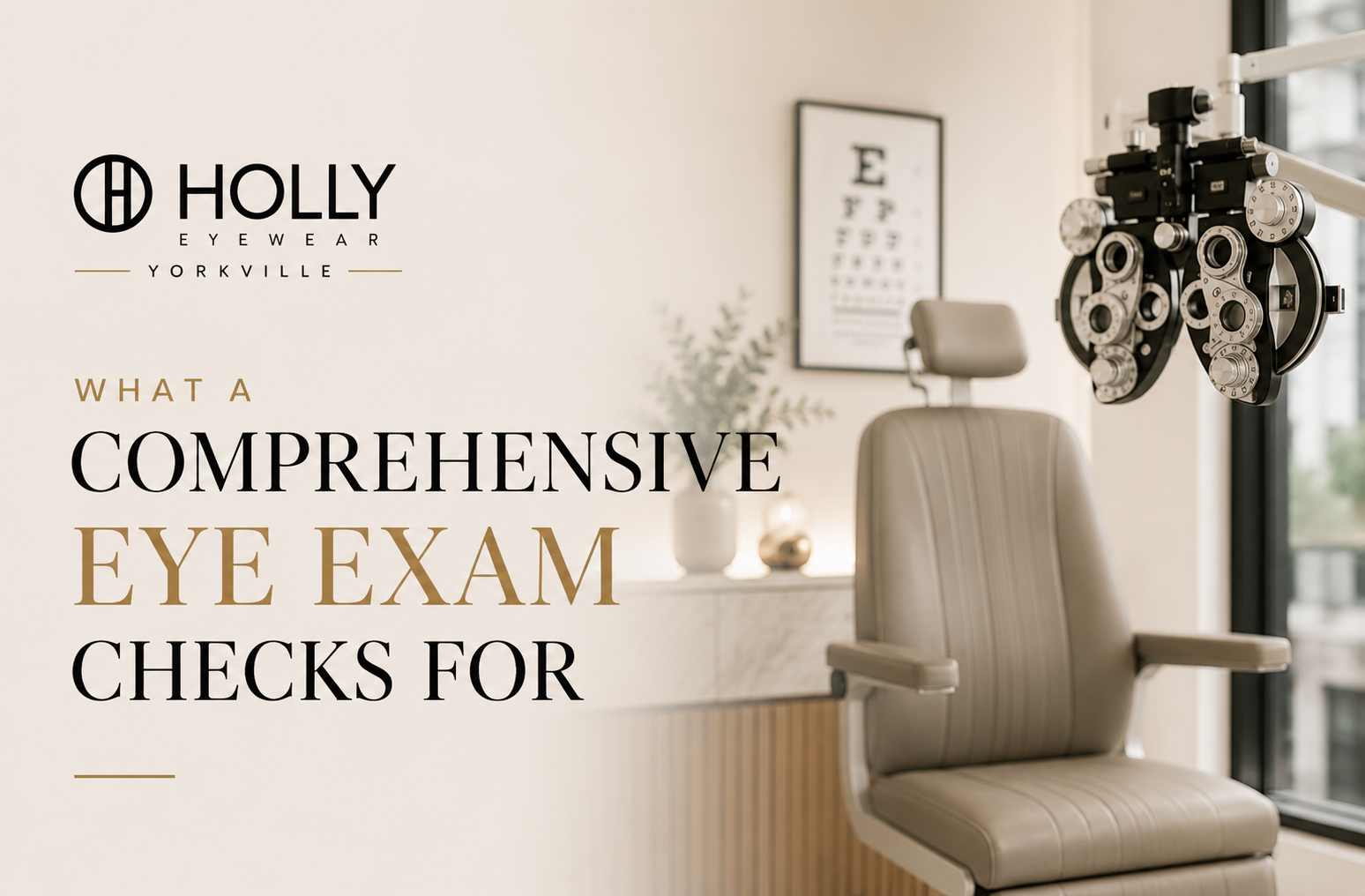
A comprehensive eye exam covers the full health of your eye — and in some cases, signals that go beyond it. Here's what Dr. Mateo Vacacela is assessing during an exam at Holly Eyewear:
Intraocular pressure — elevated pressure inside the eye is the primary risk factor for glaucoma, a condition that causes irreversible vision loss and often produces no symptoms until significant damage has already occurred. A quick, painless pressure test is part of every comprehensive exam.
Retinal health — the retina is the light-sensitive tissue at the back of the eye. Changes in its appearance can indicate early-stage macular degeneration, diabetic retinopathy, or retinal detachment. Caught early, these conditions are manageable. Caught late, they're not.
Optic nerve — the nerve connecting your eye to your brain. Structural changes here can signal early glaucoma or neurological changes that warrant follow-up with another specialist.
Systemic health signals — the blood vessels inside the eye are among the only ones in the body that can be viewed directly without invasive procedures. Unusual patterns in those vessels can point toward hypertension, high cholesterol, or type 2 diabetes — conditions that often go undetected for years.
Digital eye strain — with most people spending eight or more hours a day on screens, how the eyes work together and focus at close range is increasingly part of the clinical picture.

Why Your Child's First Exam Should Happen at Six Months
This is the one most parents get wrong!
The Canadian Association of Optometrists recommends that children have their first comprehensive eye exam at six months of age.
Dr. Mateo Vacacela sees why this surprises people — and why it shouldn't:
"It's all too common for children to have lazy eyes or poor vision that neither they nor their parents are aware of. Children often are not aware of what is normal and abnormal in terms of their vision, so it is crucial they are examined early by an optometrist."
Lazy eye — amblyopia — is one of the most common vision conditions in children and one of the most treatable when caught early. The window for effective correction is widest in the first years of life. Once it closes, the options narrow significantly.
Children who struggle to see clearly in the classroom rarely identify it as a vision problem. They adapt. They sit closer to the board. They avoid reading. Their parents and teachers often interpret this as a learning or attention issue rather than an uncorrected vision problem. An exam at six months, and annually through childhood, removes that uncertainty.

How to Prepare for Your Appointment
A few things make the exam more efficient — and the results more useful.
Dr. Mateo Vacacela's advice:
"Make sure you bring all your pairs of glasses that you are currently using. If you wear contacts, it's ideal to know the brand and model you are wearing — or simply take a picture of your current box of contacts."
One thing most people don't think to bring: sunglasses. If your optometrist dilates your eyes as part of the exam, your pupils will be sensitive to light afterward. Having a pair ready makes the trip home considerably more comfortable.
What Happens After Your Exam at Holly Eyewear
This is where Holly Eyewear is different from a standard optometry clinic.
As Dr. Mateo Vacacela puts it:
"Be sure to set aside some time after the exam so you can have a professional frame styling and fitting with Holly!"
The exam tells you what your eyes need. Holly tells you what's going to look and feel right — and fits it properly. It's not two separate appointments. It's one visit that covers both. That's the practical advantage of having an optometrist and a boutique eyewear collection in the same space on Cumberland Street.
Frequently Asked Questions
How often should adults get a comprehensive eye exam?
The standard recommendation for adults without existing eye conditions is every one to two years. For adults 65 and older, OHIP covers one comprehensive eye exam every 18 months if you have no eligible eye condition — and annually if you have a qualifying condition such as glaucoma, diabetes, or macular degeneration. Children and youth 19 and under are covered once per year. Adults between 20 and 64 without a qualifying condition should check their extended benefits, as most plans include annual or biennial coverage.
At what age should my child have their first eye exam?
Six months — earlier than most parents expect. The Canadian Association of Optometrists recommends exams at six months, age three, and before starting school, then annually through childhood. Early detection of conditions like amblyopia (lazy eye) is critical because the window for effective treatment is widest in the first years of life.
What should I bring to my eye exam?
All your current glasses, your contact lens brand and model (or a photo of the box), your provincial health card, and any insurance information. If dilation is likely, bring sunglasses for afterward.
Your prescription is one part of the picture. Your eye health, your child's vision, and the frames that work for your life are the rest of it.
Dr. Mateo Vacacela is in clinic every Tuesday at Holly Eyewear on Cumberland Street in Yorkville. Book your eye exam and leave time afterward for the fitting.