
How to Read Your Eyeglass Prescription, Line by Line
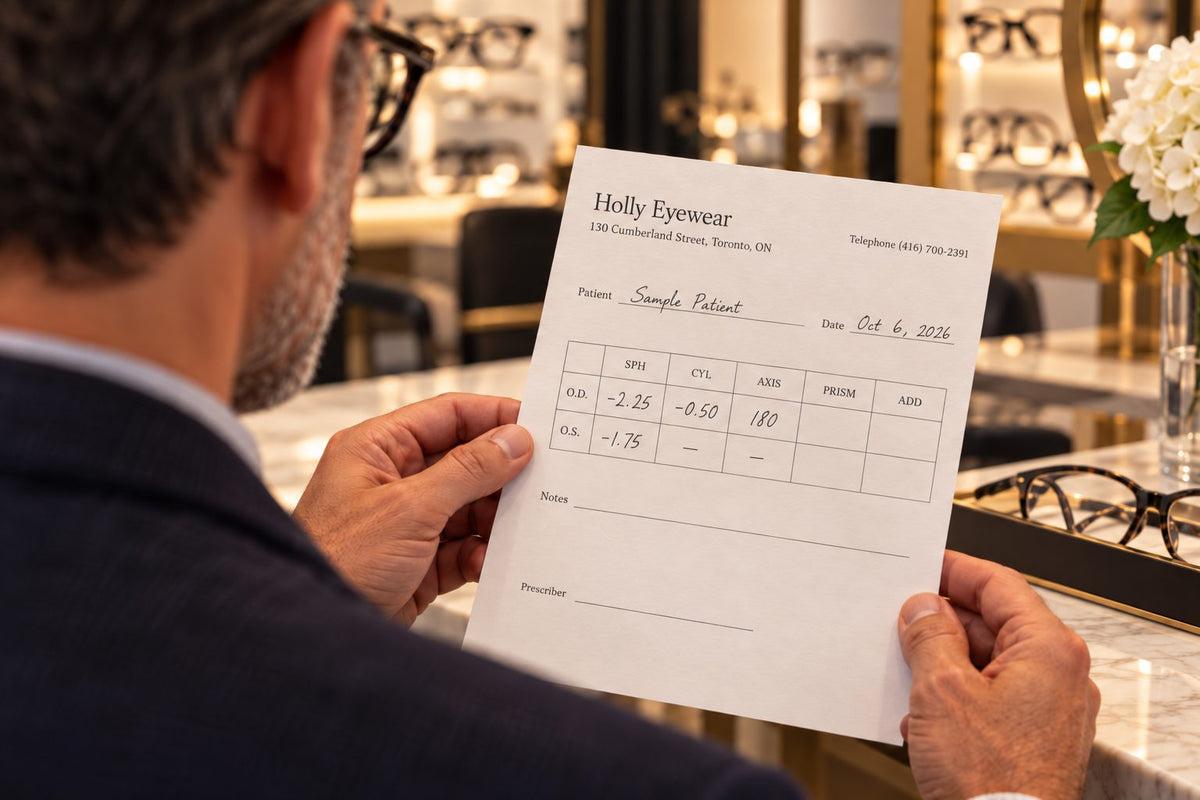
You’ve just finished your eye exam, and someone hands you a slip of paper that looks like a lottery ticket filled out in Latin. OD. OS. SPH −2.25. CYL −0.50. Axis 180. You nod as if it all makes sense, fold it into your wallet, and trust that someone, somewhere, can read it.
Someone can. At Holly Eyewear, our boutique at 130 Cumberland Street in Yorkville, we read them every day. But October is when plenty of people book an exam before their vision benefits reset, then head straight to choosing frames. That second conversation goes faster, and is a lot more fun, when you know what you’re holding.
An eyeglass prescription is a set of instructions for your lenses: one row per eye, with numbers for overall lens power (SPH), astigmatism (CYL and axis) and any extra reading power (ADD). Once you know what each line means, an optician can turn it into lenses that suit your frames and the way you actually use your eyes.
Here’s the sample prescription we’ll decode together:
| SPH | CYL | Axis | ADD | |
|---|---|---|---|---|
| OD (right eye) | −2.25 | −0.50 | 180 | — |
| OS (left eye) | −1.75 | — | — | — |
What do OD and OS mean on a prescription?
OD stands for oculus dexter, which is Latin for your right eye. OS stands for oculus sinister, your left eye. Each eye gets its own row because each one is measured separately, so read across a row to see everything your right or left eye needs, rather than reading down the columns.
The Latin isn’t a test. It’s shorthand that never went out of style. In our sample, the right eye has a little more going on than the left, and that’s perfectly normal. Your eyes are a pair, not twins.
What does SPH mean, and why is there a minus sign?
SPH, or sphere, is the main lens power your eye needs, measured in dioptres. A minus sign means you are nearsighted and need help seeing things far away. A plus sign means you are farsighted and need help seeing up close. The further the number sits from zero, in either direction, the stronger the prescription.
The American Academy of Ophthalmology compares it to a number line with zero in the middle: −0.75 is a gentle nudge, −6.00 is a lens doing real heavy lifting. A bigger number isn’t a grade on your eyes. Nobody is handing out report cards.
Lens power can affect how thick the finished lenses are, so show your prescription to the optician before you fall for a frame. It’s easier to fall in love wisely.
What do CYL and axis mean?
CYL, or cylinder, measures astigmatism. That happens when the front of the eye is curved more like a football than a basketball, so light focuses unevenly. The axis, written as a number from 1 to 180 degrees, tells the lab which direction that astigmatism lines up. A blank or dashed CYL box means no astigmatism correction is needed.
The axis trips people up because it’s a direction, not a strength. An axis of 180 isn’t worse than 90, the same way north isn’t worse than east.
What is ADD on a glasses prescription?
ADD is extra magnifying power added to the lower part of the lens for reading and close work. It shows up most often after about age 40, when many people find small print harder to focus on. If your prescription has an ADD value, you will usually be choosing between reading glasses, bifocals and progressive lenses.
If you’ve started holding the menu at arm’s length at dinner, you already know the feeling. The right option depends on your day, and frame shape matters too, since the lens needs room for each zone. Ask about lens options while you choose frames; our guide on how to choose frames for your face shape makes a good warm-up.
A column marked Prism, according to the AAO, is a correction for some people who experience double vision. On most prescriptions, it’s blank.
Can I use my glasses prescription to buy contact lenses?
No. Contact lenses sit directly on the eye, so a contact lens prescription includes extra measurements that are specific to the size and brand of the lens. You will need a separate contact lens fitting with an eye care professional before contacts can be ordered, even if your glasses prescription is brand new.
If you wear both, keep the two prescriptions together and label them. They look like cousins on paper, and they aren’t interchangeable.

How long is an eyeglass prescription good for?
A prescription is only as current as your last exam. The Canadian Association of Optometrists recommends a comprehensive eye exam every two years for low-risk adults aged 20 to 64, every year for adults 65 and older, and every year for school-age children. Your optometrist may recommend a different schedule based on your eye health.
That guidance comes from the CAO’s position statement on eye exam frequency. If your prescription is older than that, your glasses just feel off, or night driving has started to feel harder, book an exam before you order new lenses. Putting beautiful new frames on an old prescription is like tailoring a suit to last year’s measurements: gorgeous, and slightly wrong.
At Holly Eyewear, Dr. Mateo Vacacela sees patients for comprehensive eye exams on Tuesdays.
Frequently Asked Questions
Is a higher prescription number bad for my eyes?
A higher number means the lens needs more power to correct your vision. It measures correction, not eye health. Only a comprehensive eye exam can tell you how healthy your eyes actually are.
Why does my prescription have different numbers for each eye?
Each eye is measured on its own, and the two often need slightly different corrections. Your lenses are made to match each row.
Does a blank or dashed box on my prescription mean something is missing?
Usually not. A blank or dashed CYL, axis, ADD or prism box typically means that type of correction isn’t needed for that eye. If anything looks unclear, ask the clinic that wrote the prescription before you order.
What should I bring when I order new glasses?
Bring your eyeglass prescription (not only your contact lens one), your current glasses, and your benefits information if you plan to make a claim. Mention anything that has changed since your last exam, like headaches or trouble with glare.
Not sure your prescription is still current? Book an eye exam in Yorkville with Dr. Mateo Vacacela, who sees patients on Tuesdays. You can request an appointment online. Already have an up-to-date prescription? Browse our optical frames or bring it by the boutique. Walk-ins are welcome for optical, and we’re always happy to translate the Latin.
Holly Eyewear · 130 Cumberland St, Yorkville, Toronto, ON · (416) 700-2391