
Night Driving Glare: Why Fall Evenings Feel Harder on Your Eyes
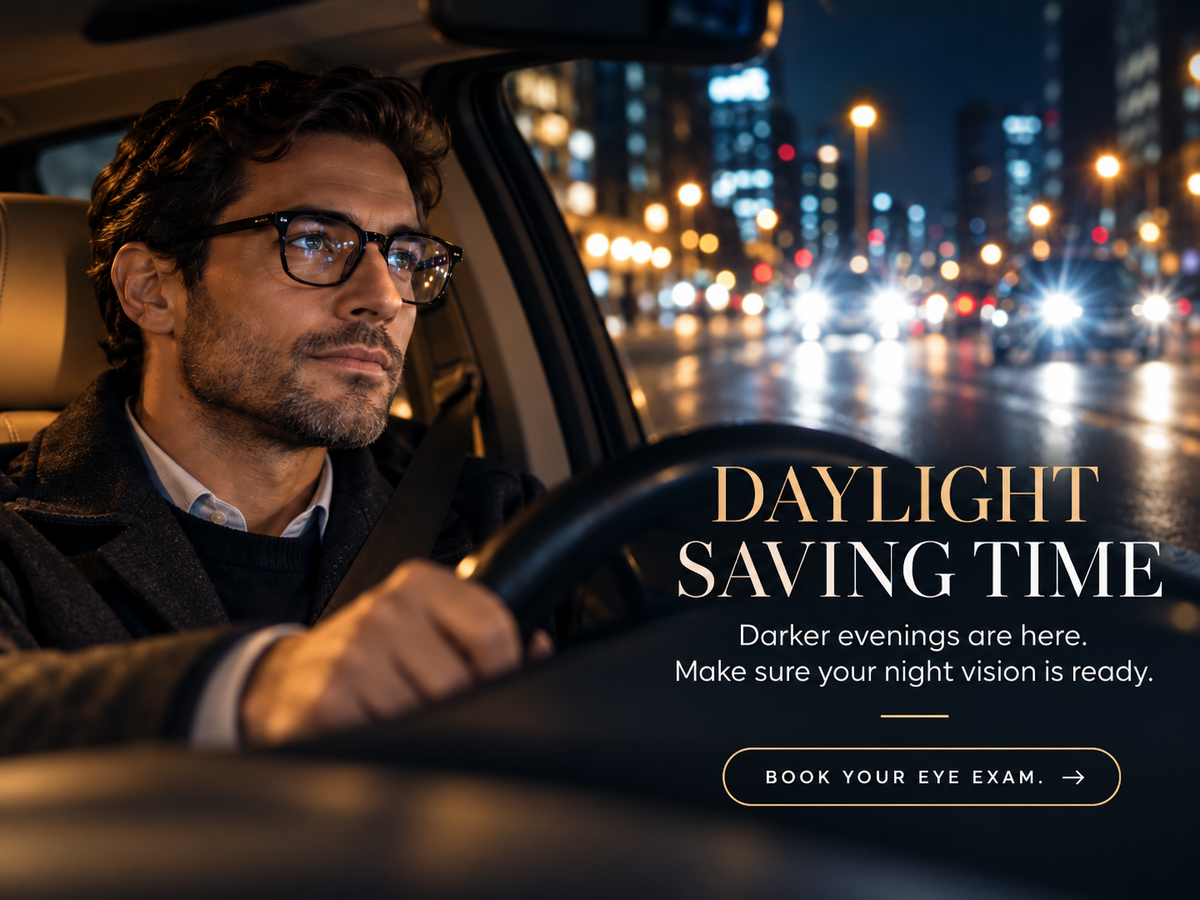
It usually starts the week the clocks fall back. You leave work, it’s already dark, and the drive home up Avenue Road or along the DVP suddenly feels like a different sport. Headlights seem brighter. Streetlights come with halos. Wet pavement throws every reflection straight back at you, and road signs take a beat longer to read than they did in August.
You’re not imagining it. Night driving glare is one of the most common things people notice once fall arrives in Toronto. Some of it is simple physics. Some of it comes down to your glasses. And some of it is your eyes telling you it’s time for a check-up. Here’s how to tell the difference before a Thanksgiving drive or a darker commute.
The short answer: night glare usually comes down to your glasses, your prescription or your eyes themselves. Clean or replace scratched lenses, skip the yellow night driving glasses, and book an eye exam if glare and halos are new or getting worse.
Why does night driving feel harder in the fall?
Because more of your driving happens in the dark, and the dark is where small vision problems show up. Your pupils widen at night to let in more light, which makes an outdated prescription, smudged or scratched lenses, and dry eyes more noticeable as blur, glare and halos around lights.
The American Academy of Ophthalmology explains that pupils get larger in low light, and that if you need glasses or a new prescription, your night vision will be blurry just like your daytime vision. In daylight, there’s enough light to mask a small focusing problem. On a dark November evening, that cushion disappears.
Fall in Toronto stacks the deck, too. Daylight saving time ends on Sunday, November 1, so for many commuters the drive home moves into darkness almost overnight. October rain puts a reflective sheen on every road, and the Thanksgiving long weekend sends plenty of people north to cottage country just as the sun goes down.
What causes glare and halos around headlights?
The most common causes are an out-of-date prescription, dirty or scratched lenses, worn lens coatings and dry eyes. Halos can also be a sign of an eye condition such as cataracts, which is why new or worsening glare at night is worth an eye exam rather than a guess.
It helps to think about glare in three places.
Your glasses. Light bounces off the front and back surfaces of every lens. Fingerprints, smudges and fine scratches scatter that light further, which is why a pair that looks fine at your desk can turn every headlight into a starburst at night. Anti-reflective coatings are designed to cut down those lens-surface reflections, but a coating that’s scratched or peeling can make things worse instead of better.
Your prescription. A small change you’d never notice in daylight becomes obvious in the dark. If it’s been a couple of years since your last exam, that alone can explain a lot.
Your eyes. The American Academy of Ophthalmology lists dry eye among the normal changes that can reduce the quality of your vision at night, and names cataracts, a gradual clouding of the eye’s natural lens, as a common cause of glare and halos around lights. Neither is something you can diagnose from the driver’s seat. That’s what a comprehensive eye exam is for.
Do yellow “night driving glasses” actually work?
The best research so far says no. A 2019 study published in JAMA Ophthalmology found that yellow-tinted night driving lenses didn’t help drivers spot pedestrians or reduce the effect of headlight glare compared with clear lenses. Any tint cuts the light reaching your eyes, at exactly the moment you need more of it.
You’ll see them advertised every fall, usually with big promises about seeing better after dark. The American Academy of Ophthalmology’s summary of that study was blunt: the yellow lenses didn’t live up to the product claims. Things may look brighter through a yellow lens, but looking brighter and actually seeing more aren’t the same thing on a dark road.
The same logic applies to wearing sunglasses or any tinted lens after dark. If glare is the problem, the fix starts with finding out why it’s happening, not with adding a filter on top.
When should you book an eye exam for night driving problems?
Book an exam if glare, halos or blurry vision at night are new, getting worse, or making you avoid driving after dark. The American Academy of Ophthalmology lists glare or halos around oncoming headlights and streetlights among its red flags for driving safety, so it isn’t something to wait out.
Even without symptoms, regular exams matter. The Canadian Association of Optometrists recommends that low-risk adults have an eye exam every two to three years between ages 20 and 39, every two years from 40 to 64, and every year from 65 on. Your optometrist may suggest a shorter interval based on your eyes and your health.
Dr. Mateo Vacacela sees patients for comprehensive eye exams every Tuesday at our Yorkville boutique. Mention the night driving when you book, and again when you sit down for your exam. The more detail you can share (which eye, what kind of light, how long it’s been happening), the more useful the appointment.
His advice for the visit itself is simple: bring every pair of glasses you currently use, a photo of your contact lens box if you wear contacts, and sunglasses for after the exam in case your eyes are dilated. Then set aside a little time afterward for a proper frame styling and fitting.

A five-minute checklist before the clocks fall back
- Clean your glasses properly, with lens cleaner and a microfibre cloth, not the hem of your sweater.
- Hold them up to a light and check for scratches or a coating that’s starting to peel.
- Clean the inside of your windshield, too. The film that builds up on the glass catches every oncoming headlight.
- If your licence requires corrective lenses, keep a pair in the car.
- When a bright car approaches, look toward the right edge of your lane instead of straight into the headlights.
- If you’re overdue for an eye exam, book it now rather than after the first snowfall.
Frequently Asked Questions
Does anti-reflective coating help with night driving glare?
It reduces the reflections bouncing off the surfaces of your lenses, which can make night driving more comfortable for glasses wearers. It won’t fix glare that starts inside the eye, such as from dry eye or cataracts, so it works best alongside an up-to-date prescription. Ask about lens options when you choose new frames.
Should I wear sunglasses or polarized lenses at night?
No. Any tinted lens reduces the light reaching your eyes, and at night you need all of it. Save the sunglasses for low winter sun on the morning drive.
Is it normal to see halos around lights at night?
A little glare at night is common, especially on wet roads with bright headlights. Halos that are new, getting worse, or showing up more in one eye than the other are worth having checked.
Does night vision get worse with age?
Many people find night driving gets harder over time. Normal age-related changes, including dry eye, can affect vision behind the wheel, and cataracts become more common as we get older. Regular eye exams are how those changes get caught early.
If the drive home has started to feel harder than it should, start with an eye exam and finish with frames you’ll actually want to wear every day. Book a Tuesday appointment online, browse our optical collection, or stop by Holly Eyewear at 130 Cumberland Street in Yorkville, Toronto. Walk-ins are welcome for optical. Questions? Call us at (416) 700-2391.
Spending your days on screens before that drive home? Our guide to digital eye strain and what actually helps covers the daytime side of the story.